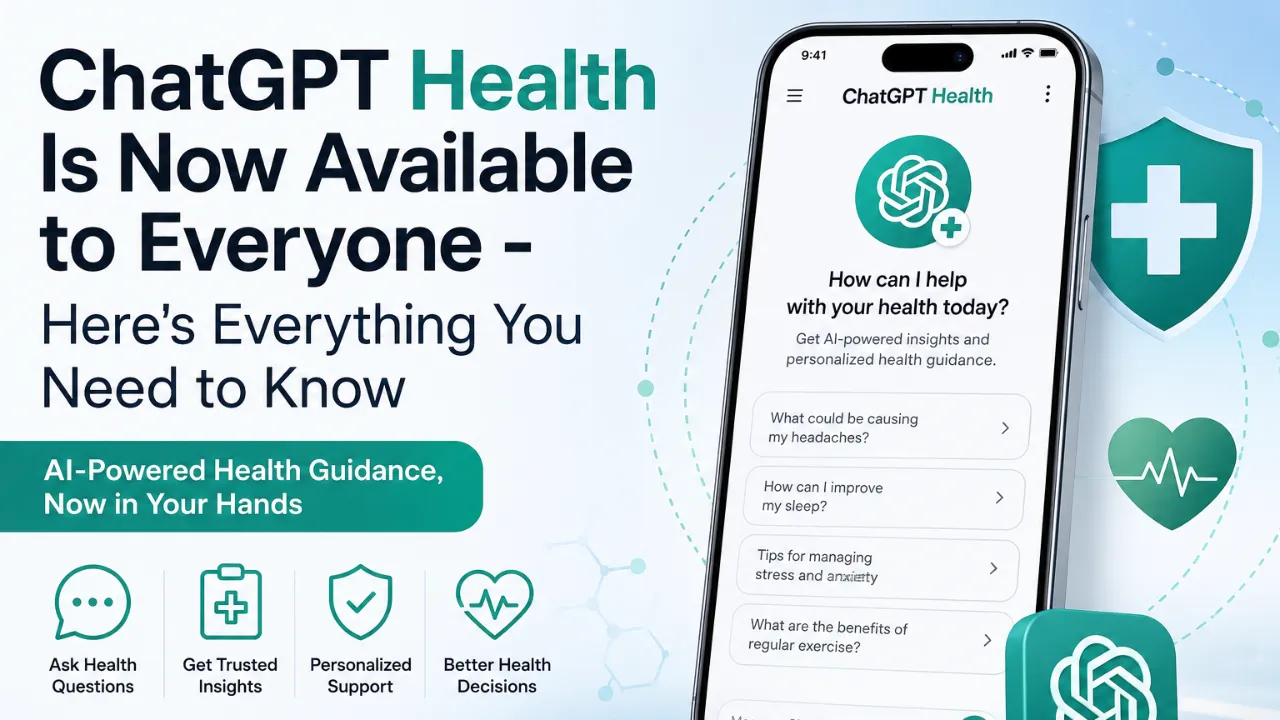
ChatGPT Health is OpenAI’s built-in feature for answering health and wellness questions using both general medical knowledge and, if you choose to connect them, your own personal health data — from Apple Health steps and sleep data to lab results synced from providers like Epic. As of this week, it’s available to every logged-in U.S. user over 18, on every ChatGPT plan, on web and iOS.
What Changed in This Rollout
From Test Hub to Every Chat
When OpenAI first introduced Health back in January, it lived inside a separate, dedicated hub — you had to go looking for it. That’s no longer the case. Health-related context can now surface inside any regular conversation, not just the special section built for it.
That shift matters more than it sounds. During the testing period, OpenAI found that roughly 70% of health-related questions were happening outside the dedicated hub anyway — people were asking about symptoms, food, or allergies in the middle of everyday chats, not in a separate “health mode.” Folding the feature into general chat simply matches how people were already using it.
Who Can Use It Now
The rollout covers logged-in U.S. users on Free, Go, Plus, and Pro plans, on both the web app and iOS, starting this week. It’s restricted to users 18 and older.
How ChatGPT Health Actually Works
Connecting Apple Health, MyFitnessPal, and Fitness Apps
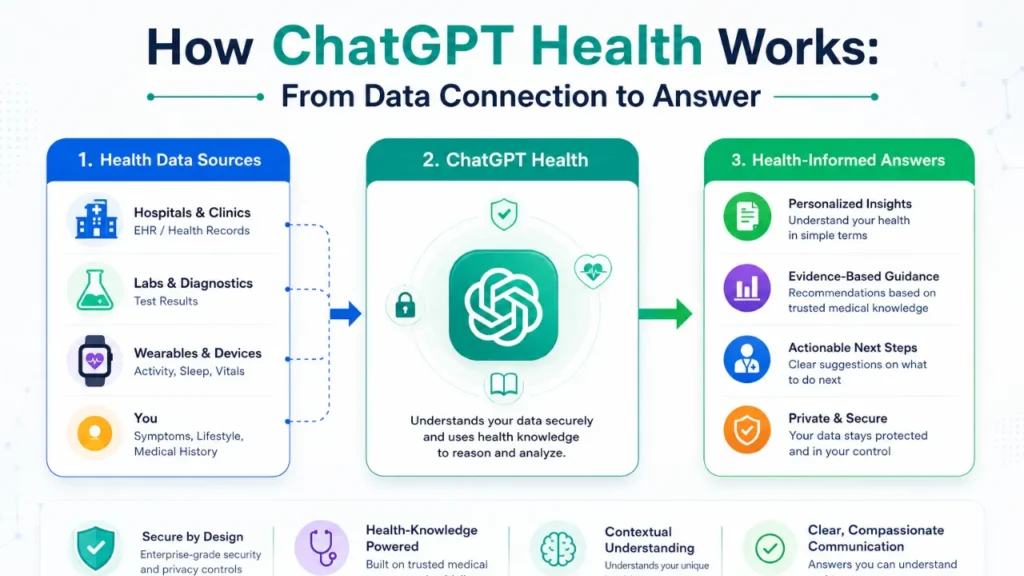
Users can link personal data from consumer apps like Apple Health, MyFitnessPal, and Function to give ChatGPT context — think activity levels, nutrition logs, sleep patterns, or heart rate trends. Once connected, that data can inform answers even in unrelated conversations, like a question about which snack fits your macros for the day.
Linking Medical Records
Beyond fitness apps, ChatGPT Health also supports connecting actual medical records — pulling data from hospital and health-record systems such as Epic and Oracle Health, plus platforms like One Medical and Function Health. In theory, this lets the assistant reference things like recent lab work or diagnosis history when you ask a related question.
Step-by-Step: Turning On ChatGPT Health
- Open ChatGPT on web or iOS and make sure you’re logged in with a U.S. account.
- Go to the Health section in Settings (or the dedicated Health hub, if still shown on your account).
- Choose which services to connect — Apple Health, MyFitnessPal, Epic, Oracle Health, One Medical, or Function Health.
- Authorize each connection through that service’s standard permissions screen.
- Start chatting normally — connected health context can now inform answers anywhere in ChatGPT, not just inside the Health hub.
You can disconnect any linked service at any time from the same settings menu if you change your mind.
The Numbers Behind the Launch
OpenAI’s own figures show how fast health-related usage has grown. Back when Health first launched in testing, the company said users were sending around 230 million health-related messages every week. That number has since climbed to 300 million a week — a roughly 30% increase in just a few months, and a clear signal of how much people already lean on ChatGPT for health questions, feature or no feature.
Is ChatGPT Health Accurate? What HealthBench Actually Measures
OpenAI evaluates its models against HealthBench, an open-source benchmark it built specifically to test how well large language models handle health-related questions, developed in collaboration with physicians. According to OpenAI, even its smallest newer model, GPT-5.6-Luna, scores higher on HealthBench than the previous GPT-5.5 model.
That’s a genuinely useful data point — but it’s worth reading carefully. A benchmark score tells you a model is improving at structured health-question tasks; it doesn’t mean the model is a substitute for a licensed clinician evaluating your specific case, medical history, and symptoms in person. OpenAI itself doesn’t claim otherwise: its own terms of service state its products are “not intended for use in the diagnosis or treatment of any health condition.”
Privacy: Does OpenAI Use Your Health Data to Train Its Models?
According to OpenAI, user data connected through Health is not used to train its models, and the company says it works with physicians to refine how its models handle health questions. If privacy is a concern, it’s worth reviewing exactly which data categories you’re authorizing before connecting any third-party health service — and remembering that you can revoke access at any time.
Why This Launch Is Controversial Right Now
The Lawsuit Behind the Timing
The timing here isn’t a coincidence. This nationwide rollout arrived just one day after a Florida-based pastor filed a lawsuit against OpenAI, alleging the chatbot gave a near-fatal suggestion that discouraged him from seeing a doctor. OpenAI has pointed to its terms of service — which explicitly state the product isn’t meant for diagnosis or treatment — in response to the suit, and has told reporters it’s working to make health-related answers safer going forward.
What Independent Research Says About AI Health Advice
The lawsuit isn’t an isolated data point. Multiple independent studies, including research from the University of Oxford and coverage summarized by News-Medical, have raised concerns that AI chatbots — across providers, not just OpenAI’s — can give problematic or unreliable medical advice in certain scenarios. None of this has stopped the broader industry from moving forward, though: Anthropic launched Claude for Healthcare in January, and Google added an AI-powered health and fitness coach to Fitbit devices in 2025.
ChatGPT Health vs. Claude for Healthcare vs. Google’s Fitbit AI Coach
| Feature | ChatGPT Health (OpenAI) | Claude for Healthcare (Anthropic) | Fitbit AI Coach (Google) |
|---|---|---|---|
| Availability | All U.S. users 18+, all plans | Rolled out January 2026 | Fitbit device owners |
| Data integrations | Apple Health, MyFitnessPal, Function, Epic, Oracle Health, One Medical | Enterprise/health-system focused | Fitbit activity & sleep data |
| Where it works | Any ChatGPT conversation | Health-specific workflows | Fitbit app |
| Clinical intent | Explicitly not for diagnosis/treatment | Positioned for clinical support contexts | Wellness/fitness coaching |
| Benchmark cited | HealthBench | Not publicly specified in the same way | Not applicable |
Note: Feature sets and availability change quickly in this space — always check each provider’s current documentation before relying on comparisons.
Should You Use ChatGPT Health? Pros and Cons
Pros:
- Convenient — no need to switch apps to ask a quick health or nutrition question
- Can factor in your actual activity, diet, or medical history if you choose to connect it
- Backed by a dedicated benchmark and physician input, according to OpenAI
- Free to use at a basic level across all plan tiers
Also read;
OpenAI Wants ChatGPT to Become Your Next Super App – Here’s What That Could Mean
AI Skills Race Is Coming for the Auto Industry as Car Companies Rethink Jobs
Anthropic Pushes Claude Deeper Into Legal AI as Competition Heats Up
Cons:
- Not designed or approved for diagnosis or treatment
- Independent research suggests AI health advice can be inconsistent or wrong
- Connecting medical records means sharing sensitive data with a third-party AI system
- A live lawsuit alleges a serious real-world harm tied to health-related chatbot advice
Common Mistakes to Avoid
- Treating ChatGPT Health as a replacement for a doctor visit — it’s explicitly not designed for that.
- Connecting every available data source without reviewing what’s shared — be selective.
- Ignoring red-flag symptoms because a chatbot response sounded reassuring — always err toward professional care for anything serious or urgent.
- Assuming benchmark improvements equal clinical reliability — HealthBench measures model performance on structured evaluations, not real-world outcomes.
Best Practices for Using AI Health Tools Safely
- Use it for general education, not diagnosis — think “help me understand this term” rather than “tell me what’s wrong with me.”
- Always verify anything important with a licensed healthcare provider.
- Review your connected data sources periodically and disconnect anything you no longer want linked.
- If a response ever tells you not to see a doctor for a concerning symptom, treat that as a reason to seek care anyway, not a reason to skip it.
13. Key Takeaways
- ChatGPT Health is now live for all logged-in U.S. users 18+, across every plan, on web and iOS.
- It can now surface health context in any conversation, not just a dedicated hub — because most usage was already happening that way.
- Weekly health-related queries have grown from 230 million to 300 million.
- OpenAI says it doesn’t train models on this health data and cites HealthBench improvements with its newest small model.
- The rollout follows a lawsuit alleging harmful health advice, and independent research continues to flag reliability concerns with AI medical guidance.
- OpenAI’s own terms state the product isn’t intended for diagnosis or treatment — a caveat worth taking seriously.
14. FAQs
What is ChatGPT Health?
A feature that lets ChatGPT answer health and wellness questions, optionally using your connected personal health data from apps like Apple Health or medical records from systems like Epic.
Is ChatGPT Health free to use?
Yes — it’s available on the Free plan as well as Go, Plus, and Pro tiers for logged-in U.S. users 18 and older.
Can ChatGPT Health diagnose medical conditions?
No. OpenAI’s terms of service explicitly state its products aren’t intended for diagnosis or treatment of any health condition.
What apps and services can I connect to ChatGPT Health?
Apple Health, MyFitnessPal, and Function for personal fitness/wellness data, plus Epic, Oracle Health, One Medical, and Function Health for medical records.
Does OpenAI use my health data to train ChatGPT?
According to OpenAI, no — the company says it doesn’t use user data from Health to train its models.
What is HealthBench?
An open-source benchmark OpenAI developed, with input from physicians, to evaluate how well AI models answer health-related questions.
Is ChatGPT Health available outside the U.S.?
As of this rollout, it’s specifically for logged-in U.S.-based users; availability elsewhere hasn’t been announced.
Why did OpenAI roll this out now?
The expansion follows months of testing since January and comes as usage of health-related queries has grown substantially — though it also lands just a day after a lawsuit over allegedly harmful health advice.
Is it safe to rely on ChatGPT for medical advice?
Independent research has flagged reliability concerns with AI-generated medical advice generally. Use it for general understanding, and always confirm anything important with a licensed healthcare provider.
How is ChatGPT Health different from Claude for Healthcare?
Both let an AI assistant engage with health-related questions, but they’re positioned differently — ChatGPT Health targets general consumer use inside everyday chats, while Anthropic’s offering has leaned toward healthcare-context workflows. Check each company’s current documentation for specific.
1 thought on “ChatGPT Health Is Now Available to Everyone – Here’s Everything You Need to Know”